“A canal passes through an outlying part of the parish. The bargemen who frequented this canal were a special object of Mr Dodgson’s care. Once, when walking with Lord Francis Egerton… he spoke of his desire to provide some sort of religious privileges for them. “If only I had £100” he said “I would turn one of those barges into a chapel” and, at his companion’s request, he described exactly how he would have the chapel constructed and furnished. A few weeks later he received a letter from Lord Francis to tell him that his wish was fulfilled, and that the chapel was ready. In this strange church, which is believed to have been the first of its kind, Mr. Dodgson conducted service and preached every Sunday evening!”
So wrote Stuart Dodgson Collingwood in 1898, nearly 60 years after the launch of Preston Brook’s chapel boat.
He was romanticising a little, for the Floating Chapel, or Mission Boat, of Preston Brook was not the first of its kind by a long shot, and Lord Egerton was already working on a similar boat for Castlefield in Manchester, but it’s undoubtedly thanks to Reverend Dodgson that Preston Brook got it’s chapel.
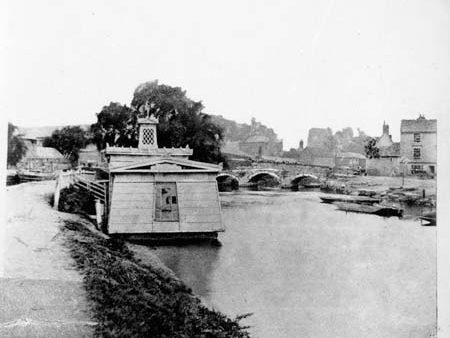
Rev Dodgson, like many at the time, was deeply concerned that boatmen were rough, crude and in dire need of spiritual instruction to prevent further degradation. It wasn’t a totally unfair assessment of the boating class, as there had been numerous displays of rape and murder on the canal, with the murder of Christina Collins in 1839 throwing the boaters religious state, or lack of, into a sharp relief and spurring on the religious reform.
Floating chapels were not a new idea, 1825 the Evangelical Anglican magazine noted drily that, “The British public have ascertained that sailors have souls as well as bodies” and commented that existing floating chapels, libraries etc had all been the work of “dissenters” and there is some evidence to suggest that as early as 1800 there was some form of boat-based religious activity at Preston Brook.
In 1841 Lord Egerton, as the proprietor of the Bridgewater canal where Christina had boarded the boat, gave evidence to the Select Committee who had been assembled to discuss whether or not there should be some sort of stoppage on the canals on a Sunday.
Egerton described the steps he had taken to get boaters to observe the Sabbath since he had come into possession of the revenues of the Bridgewater Trustees, which included putting a stoppage on Bridgewater Trustee boats for several hours on a Sunday as early as 1837.
He mentioned specifically for Runcorn that he was trying to get a floating chapel instead of a warehouse space and ruefully noted that he didn’t think the morality of Runcorn boaters had improved much, and the floating chapel the Trustees had in Manchester was poorly attended.
His report for Preston Brook however was much more favourable. The floating chapel was an old flat, capable of about 200 persons, and almost always full. Unfortunately however, “the extensive parish was so destitute of accommodation for public worship similar to that of the floating chapel, that it was attended by people with no connection to the canal which resulted in not more then 30 or 409 boat persons being able to attend it, so that it is very crowded and of limited advantage to the floating population.”
Lord Egerton was a little unfair in this assessment of a lack of canal connection, as the bulk of the people attending the chapel were attached to the warehouses at Preston Brook, and in the limited benefit to the boaters. Reverend Dodgson had taken to the task with more then his usual vigour and was conducting all the usual Sunday services as well aswell as holding lectures on a Thursday evening. He also trained up an assistant curate for the boat, paid for by the Bridgewater Trustees. This curate:
“conducted Sunday and weekday services, superintended daily and Sunday schools especially meant for school children, visited the men on the canal and river boats and also on sea-going vessels and organised, in fact, any and every sort of machinery whereby the adult floating population connected to the port might hear the glad tidings of salvation though Jesus Christ and their children might be brought under wholesome influences.“
Dodgsons ability was a huge part in the popularity of the Chapel as, while many boaters could neither read nor write, they had exceptional memories and easily learned the lessons ‘translated’ from the King James bible by a skilled orator such a Dodgson.
Dodgson of course was far too competent to remain forever in such a place as Daresbury and his successor, Reverend John Brasher Fawkes, refused point blank to live in the isolated parsonage and went off to the Isle of Wight by 1844 for “health reasons.” Without a keen preacher backing it, the chapel started to fall out of favour. The wharf itself quickly became something of a non-conformist hotspot and some of it’s own men qualified as Methodist preachers, and in the absence of a regular Vicar they could learn to trust, it appears that the boaters began to lean to the men they knew instead. There is some evidence that the floating chapel hosted Methodist preaching, perhaps by the wharfmen themselves, but this is still under research.
By 1860 the floating chapel was no longer floating. She had been an old boat when she was converted and after a while maintaining her as watertight was more then she was worth, so she was craned out and situated on the bank near the Norton Warehouse.
The 1860 Directory of Cheshire describes her thus:
Preston Brook. Lord Ellesmere having here a large establishment of clerks, boatmen etc, supports a watermen’s church and school as well as a scripture reader. The Sunday evening service is conducted by Reverend James Cox. The church was originally built for floating and has been used as such for some time but is now placed on land close to the canal
Reverend Cox was the Vicar of Halton Church, and his Parish by this time now also covered the Norton warehouses where the chapel now sat.
The chapel boat was joined by a school boat in 1857, believed to have been named Vulcan, who was intended to educate the boater’s children while their boats were being loaded or unloaded.
Despite Sir Gilbert Greenall paying to construct a brick mission church, St Faiths, in 1888, the boats remain in service until at least the turn of the century, with William Roads remembering his education there for 3pence a week under the tuition of schoolmaster James Robinson.
It’s not entirely clear what happened to the boats, but it’s believed they were ultimately destroyed by fire.
The legend of the Mission Bell
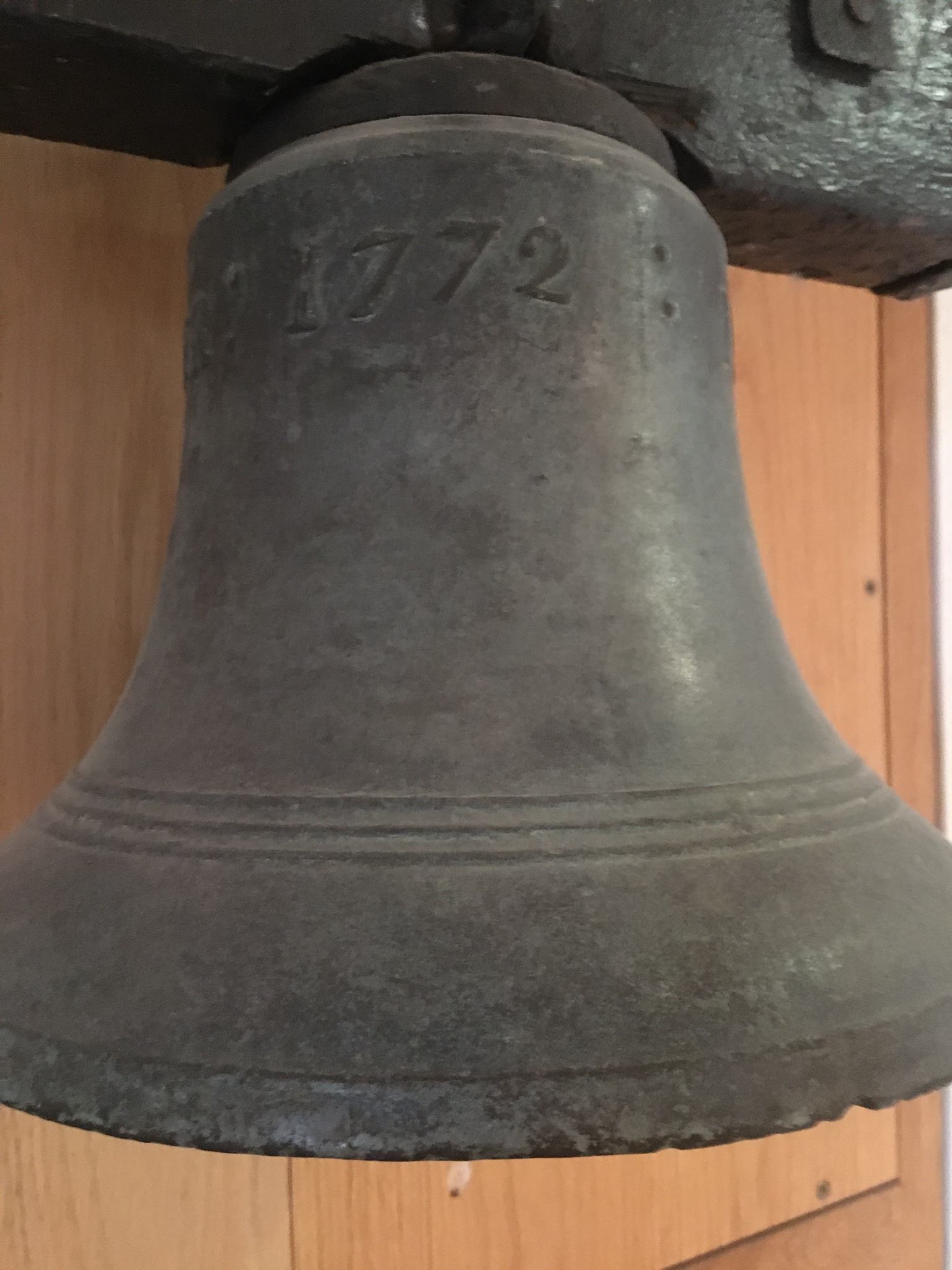
Hanging in the Lewis Carroll centre today is a curious bell, with the words “1772 Duke of Bridgwater” engraved upon it.
It’s been associated with the floating chapel for many years, but it’s unlikely to have been on board the boats at all.
The bell is a substantial one that in the restricted space of the boats would have been something of a health hazard, as well as being unable to summon it’s parishioners by being too low down for the sound to carry.
It’s quite possible that it was originally set up in the Bell Warehouse, that used to be situated directly opposite the wharf, and it was probably a multiuse bell, from sounding the alarm for fire to calling the employees to work, as well as calling men to chapel.
The Bell warehouse was demolished in 1934 for the widening of the Chester road, and perhaps after this it was moved round to the Norton warehouse. In 1974, the former Estates Manager of the Bridgewater canal recalled:
“The Duke supplied the bell which was erected at the top of the timber penthouse at the rear of the old Norton Warehouse at the corner nearest the old gas retort… When the timber penthouse fell into disrepair and became unsafe it was decided by the Bridgewater engineer to remove it sometime between 1955 and 1960. It came to light during the demolition of the penthouse.“
So perhaps there’s another bell in someone’s collection!